Philosophers & Kings
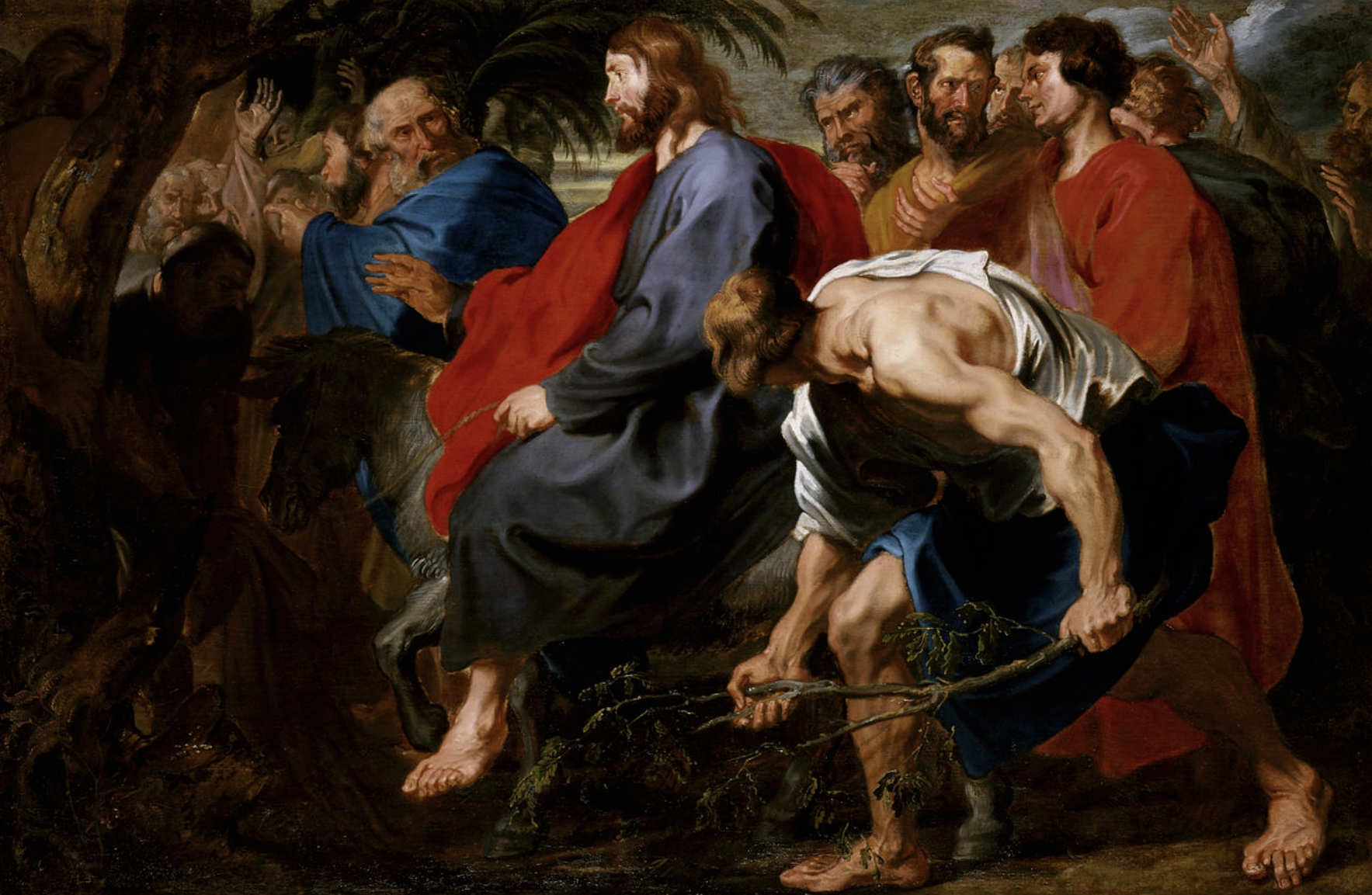
Entry of Christ into Jerusalem, Anthony van Dyck, 1617
Palm Sunday
In Book V of the Republic, Plato remarks that "there will be no end to the troubles of states, or of humanity itself, till philosophers become kings."
While the horizon of this is ultimately incorrect, we can affirm at least two things about Plato’s insight.
First, that politics must be ordered to truth.
Second, that the moral formation of rulers matters more than systems.
Plato’s “philosopher-king” is intellectually elite and elevated above the masses to an almost quasi-savior-like state.
Where this horizon is insufficient is that he overestimates philosophy’s power to save humanity because he imagines a kind of political “salvation.”
The hope of Plato’s vision is that if the right people rule, human problems can be fundamentally solved.
But this is not correct.
As St. Augustine will make clear roughly eight centuries later, the City of Man will never become the City of God within history.
Politics can restrain evil and promote justice, but it cannot redeem humanity.
The Christian answer is radically different because the true “king” is not the philosopher, but the crucified God.
And this brings us to Palm Sunday and Jesus’s triumphal entry into Jerusalem.
—
As a kid, the depth of the Palm Sunday liturgy never caught my attention, especially when there were real palm branches to collect and play with in the narthex.
I also wondered: why do we read the Passion narrative from the Gospels on the same day (Palm Sunday) that we remember Jesus’s triumphal entry?
I think it has something to do with the fickleness of the human heart, unmet expectations, and how to square this with how God is actually trying to love us.
Perhaps the Church gives these together, the Gospel of the procession and the Passion, to invite us to see a single moral revelation: the instability and brokenness of the human heart when it has not yet been fully conformed to Christ.
—
In his commentary on the triumphal entry in Life of Christ, Fulton Sheen remarks that excitement is not a religion. Otherwise an “alleluia” on Sunday becomes a “Crucify Him” on Friday.
The last few weeks we’ve been reflecting on the nature of the crowds in Matthew’s Gospel and how they’re representative of the divided heart.
We see this on full display from start to finish during Holy Week.
Jesus enters Jerusalem on a donkey to fulfill Zechariah’s prophecy about the coming king of Zion.
Rejoice greatly, O daughter of Zion!
Shout aloud, O daughter of Jerusalem!
Behold, your king is coming to you;
righteous and having salvation is he,
humble and mounted on a donkey,
on a colt, the foal of a donkey. (Zech. 9:9)
The crowd’s “Hosanna” is not false, but it is immature because it’s a cry for salvation without yet accepting the form salvation will take.
We cry “Hosanna” too. But what kind of king are we expecting?
One who removes suffering? Or one who transforms us through it?
Our temptation is to love Christ as Savior but resist Him as Lord.
Within the same liturgy, the Church has us voice both “Hosanna in the highest” and “Crucify Him.”
In just a few days, the crowds turn because Jesus refuses to be the Messiah they imagined.
He does not conform to their timeline, and He does not validate their political hopes by overthrowing Rome.
Instead, He embraces the Cross.
Do we praise Christ for His gifts but reject Him when He becomes a contradiction?
And does our praise endure when He disappoints our expectations?
—
The Church Fathers saw the donkey as a symbol of the untamed human will. Jesus’s entry (into our lives) orders it.
To welcome Christ is to allow Him to reorder our desires, and following Him is to consent to the Cross that is the path to salvation.
In this way, Palm Sunday is initiatory.
It invites us into the mystery we will walk throughout Holy Week, where we see Jesus revealing that His kingship is about self-emptying love, not domination (Phil 2: 6-11).
Every figure in the Passion becomes a mirror for the soul.
Peter (and the Apostles) are sincere but weak under pressure.
Judas is close to Christ but inwardly divided.
Pilate knows the truth, but he fears the consequences.
And the crowd is easily swayed, preferring comfort over truth.
—
What kind of king are we willing to follow and what kind of salvation do we actually want?
Do we want a king who removes the crosses of daily life? Or one who invites us to follow and encounter Him in them?
Are we willing to surrender to that kind of humility and transformation?
Palm Sunday and Holy Week ultimately confront us with these piercing questions.
This is the focal point of discipleship: growing in the courage to remain with Christ even when His way contradicts our expectations.
We’re invited this week to move from enthusiasm and admiration to surrender and obedience.
We’re invited to not just welcome Christ in theory but to follow Him in reality.
May our Hosanna be purified into fiat.
Onward and Upward,
Ted
If you’ve enjoyed these reflections, please consider a paid membership or buy me a coffee.
If now isn’t the right time, I’d be grateful if you shared Into Deep Water with a friend.