Before the Beatitudes
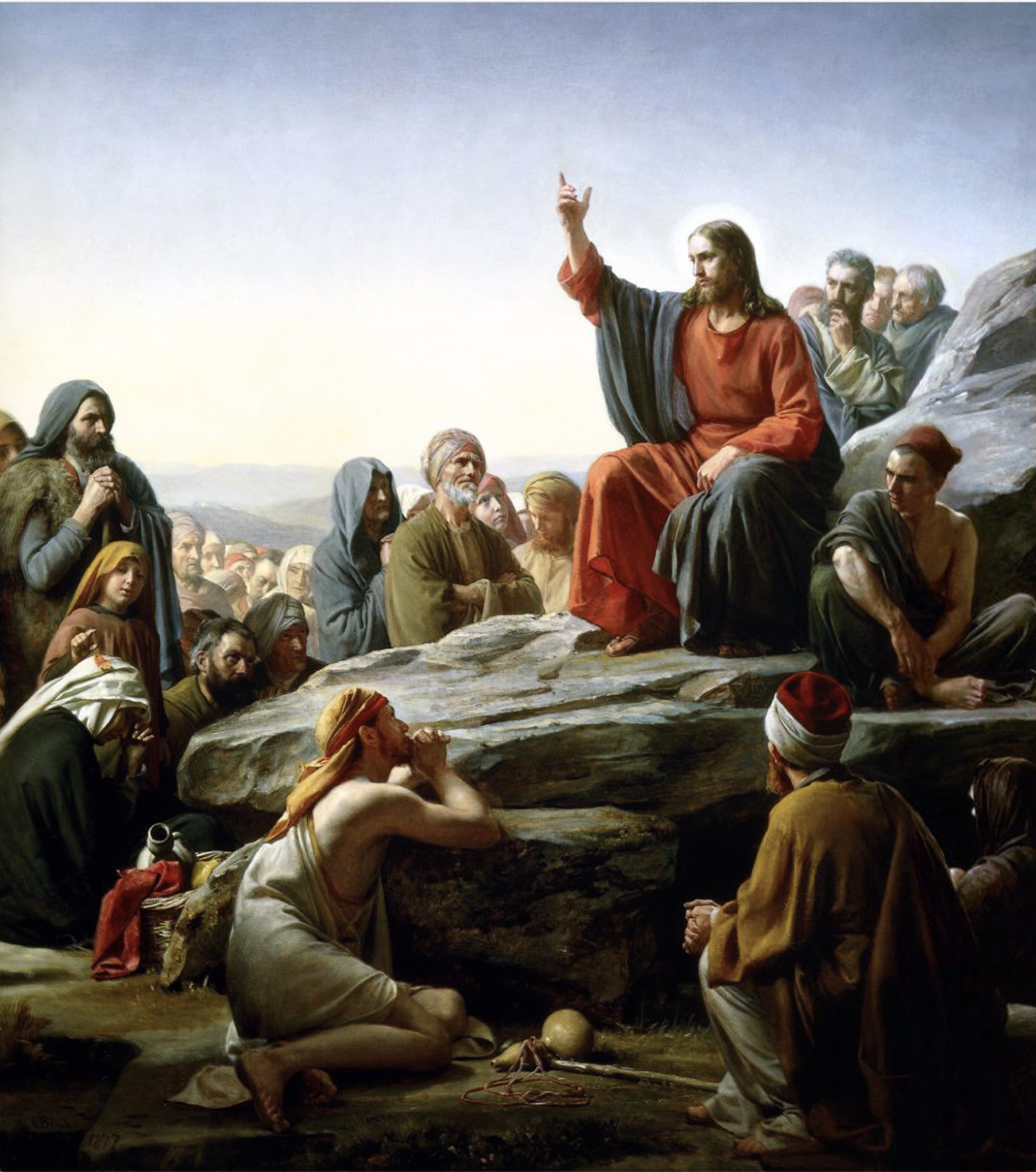
The Sermon on the Mount, Carl Bloch, 1877
“Seeing the crowds, he went up on the mountain, and when he sat down, his disciples came to him.”
—
On the surface of the text, Jesus ascends a hill and begins to teach.
Nothing too remarkable about that.
But notice the crowds.
Throughout the Gospels, they are curious but not committed.
They seek benefits without conversion (John 6:26), and they are unstable and easily swayed (Mt 27: 20-23)
The crowds represent the divided soul that we all experience.
They are the noise of competing desires, anxieties, fears, appetites, and distractions.
The disintegrated man is a crowded man. He is many things at once, and therefore, not yet his true self.
Christ sees the crowds. He does not despise them, but he does not remain among them.
This is the pattern of discipleship and growth in holiness: being seen by Christ in your fragmentation and recognizing that you cannot remain there.
—
That Jesus “went up on the mountain” is evocative of the ascent of the heart.
Throughout Scripture, the mountain is always the place of encounter with God: Sinai, Carmel, Tabor, Calvary.
Here, the mountain is also the elevation of the soul above its lower preoccupations.
To “go up” is to leave behind the tyranny of impulse, refusing to be governed by the crowd within and to seek what is higher, ordered, and eternal.
This is why St. Paul tells the Colossians that “if you have been raised with Christ, seek the things that are above, where Christ is, seated at the right hand of God.” (Col 3:1)
This ascent is not moral heroism, it is our response. Jesus goes up first.
The point here is that we do not initiate the spiritual life. Christ does, and we follow him upward, away from the noise toward clarity.
—
That “he sat down” signifies the authority of rest.
Jesus does not pace, argue, or strive. He sits because to sit is the posture of a king and a judge. And it’s also the posture of one at rest in truth.
While the world lives and teaches from agitation, Christ lives and teaches from stillness.
We must learn to sit with Christ, to become interiorly still, receptive, and governed.
We cannot receive what He’s about to give (the Beatitudes) while being internally frantic.
And the response of his followers, the disciples came to Him, is the movement of desire.
Jesus doesn’t chase them. They come to Him.
Discipleship begins precisely at the point when desire is reordered and the soul moves toward Christ out of attraction and not compulsion.
Our growth in holiness is not merely avoiding sin, it is approaching Jesus and appropriating His life in us.
It is the steady reorientation of our lives toward the presence of Christ.
In sum, Matthew 5:1 is a kind of interior liturgy:
-Christ sees our divided, crowded souls.
-He ascends, calling us upward.
-He sits in sovereign peace.
-And we, if we would be His disciples, must come.
This is the precondition for the Beatitudes.
Before “blessed are the poor in Spirit,” we must:
Leave the crowds within, ascend with Christ. Draw near, and be still.
Too often we want the wisdom of the Sermon on the Mount without the movement of Matthew 5:1.
But we cannot receive Jesus’s teaching, clarity, and blessings without the ascent and without coming close enough to be still and to be changed.
This submission and proximity is our way of life in Him.
And we become what we sit before.
So before we can receive the Beatitudes, the question for us is:
Have we left the crowd and come up the mountain to sit with Him?
Onward and Upward,
Ted
If you’ve enjoyed these reflections, please consider a paid membership or buy me a coffee.
If now isn’t the right time, I’d be grateful if you shared Into Deep Water with a friend.