Meek & Mighty, Part 2
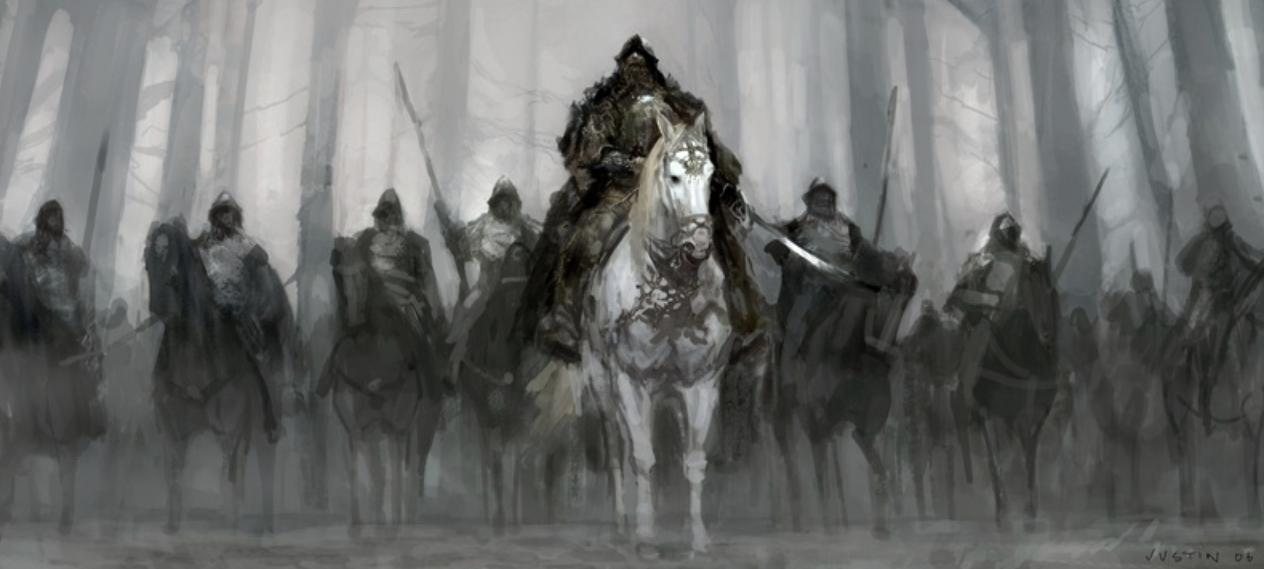
Dúnedain - Rangers of the North by Justin Sweet
Matthew 5:5 - Meek & Mighty, Part 2
“Blessed are the meek, for they shall inherit the earth.”
—
“Gentle Jesus, meek and mild” was a phrase that originated from a children’s hymn written by Charles Wesley in 1742.
The hymn was intended to teach children to pray and to approach Christ with trust and humility.
And over the centuries, its opening line became so famous that many people know the phrase even if they’ve never heard the rest of the hymn.
More recently, the phrase has often been used to portray Jesus as merely soft, passive, or sentimental.
Unfortunately that caricature has led many to think of strength as the opposite of meekness.
But this is not true.
The opposite of meekness is grasping.
The desire to possess, control, manipulate, secure, and protect ourselves apart from God.
Grasping is an Edenic impulse with ripple effects throughout salvation history.
Adam and Eve grasped.
Israel grasped.
The rich young ruler grasped.
And so did the Pharisees.
The fallen heart believes that life comes through taking hold.
Jesus reveals the opposite: life through surrender.
The kingdom does not belong to those who seize it for themselves, but to those who receive it from the Father.
—
The profound biblical reversal here is that Adam was given the earth and lost it through disobedience.
Christ relinquishes everything and inherits all things.
The First Adam reached upward and fell.
The New Adam descended downward and was exalted.
The meek, therefore, walk the path of Christ. They cease building their lives upon self-assertion and begin building upon trustful surrender.
And in doing so, they discover that the inheritance they sought through grasping can only be received through abandonment to divine providence.
—
A striking literary example of meekness appears in J.R.R. Tolkein’s The Return of the King.
The Grey Company, also known as the Dúnedain, is a group of 30 Northern Rangers and the two sons of Elrond.
In Book V Chapter 2, they ride through the Paths of the Dead with Aragorn and fight in the Battle of the Pelennor Fields.
Unfortunately, as a group they are essentially absent from Peter Jackson’s film version of the trilogy.
But in Tolkien’s books, they secretly protect the Shire for decades, and they guard the northern lands from evil while most people are unaware of them.
They also ride south to support Aragorn’s claim to the throne, and they provide a visible link between Aragorn‘s humble life as a Ranger and his identity as an heir of the ancient kingdom of Arnor.
When Gimli first beholds them, this is what he sees:
“They are a strange company, these newcomers…Stout men and lordly they are, and the Riders of Rohan look almost as boys beside them; for they are grim men of face, worn like weathered rocks for the most part, even as Aragorn himself; and they are silent.”
These are men seasoned by hardship and suffering, and they possess immense latent power.
But what strikes Legolas is their restraint:
“But even as Aragorn they are courteous, if they break their silence.”
That combination is the mark of meekness.
The truly strong and noble man does not need to advertise his strength and nobility.
The truly dangerous man does not need to threaten.
Like Aragorn himself, the Dúnedain possess authority, dignity, and power without self-display.
In this sense, they are a striking image of the meek soul.
While the world often imagines two extremes: the timid man who cannot act, or the powerful man who cannot restrain himself, Christ offers a third way.
The meek man is strong enough to act and free enough not to.
He carries power the way Aragorn carries the sword, as something entrusted to him for the sake of others.
Metaphorically, the Grey Company also illuminates the promise that "they shall inherit the earth."
The Dúnedain spend their lives in service to the true king, content to remain largely unseen. And when the kingdom is restored, they receive their inheritance precisely because they never sought to seize it.
They inherit because they remained faithful.
That is the spiritual logic of the Beatitude.
The meek soul ceases trying to conquer the world and instead learns to accompany the King.
And in accompanying Him, he discovers that what seemed like loss was preparation for inheritance.
The earth ultimately belongs to those who have learned to hold power, honor, and even their own hopes in quiet fidelity to a higher Lord.
—
Christ's words thus become a daily question:
Where am I still trying to force outcomes instead of receiving them from the Father?
Where am I demanding recognition or clinging to control?
Where am I defending my reputation or insisting that my will be done?
Every place of grasping is an invitation to meekness.
And every act of meekness is a small participation in the life of Christ.
And they shall inherit the earth because they learned the secret of the saints:
What is surrendered to God is never lost. It is transfigured and returned as inheritance.
Onward and Upward,
Ted
If you’ve enjoyed these reflections, please consider a paid membership or buy me a coffee.
If now isn’t the right time, I’d be grateful if you shared Into Deep Water with a friend.