Blessed Are You Poor
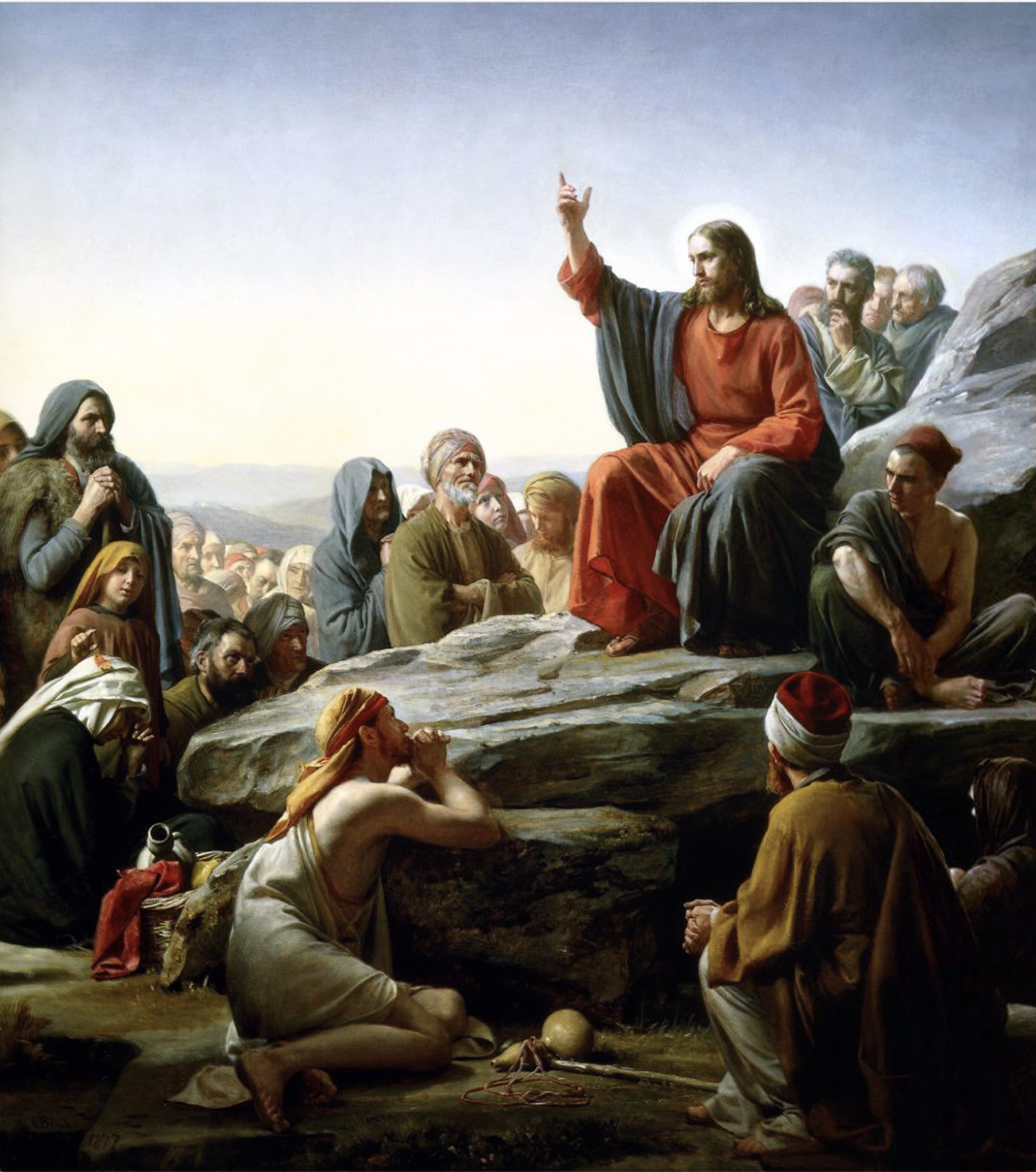
The Sermon on the Mount, Carl Bloch, 1877
“Blessed are the poor in spirit, for theirs is the kingdom of heaven.” - Matthew 5:3
—
“Poor” in the Biblical Greek has much more texture and depth than our modern English.
The word ptōchoi comes from a Greek verb (ptōssō) which literally means to crouch, cower, or huddle like a destitute beggar.
Greek has a different word for the other kind of “poor.”
πένης (penēs) was the word used for someone who simply has little money.
This referred to a working-class poor person or laborer who possessed little and toiled for their daily sustenance.
Ptōchos in Matthew 5:3 refers to the utterly destitute, one who is completely dependent upon another for survival.
In antiquity, this was the man with empty hands, someone totally needy.
Or in other words, complete existential dependence.
Someone who is spiritually bankrupt in the best possible sense.
One who knows they cannot sustain their own interior life apart from God.
In this state, there are neither illusions of self-sufficiency nor claims of moral autonomy.
—
By contrast, the Pharisee of Luke 18:9-14 is not ptōchos.
The tax collector beating his breast is.
One stands before God presenting credentials while the other crouches in need.
That posture of interior begging is the beginning of the Kingdom.
The spiritual inversion here is that the very condition that the world despises becomes the prerequisite for communion with God.
Why?
Because grace can only fill what is empty.
The soul full of itself cannot receive God.
—
The early Church Fathers saw this beatitude first fulfilled in Christ himself because in the Incarnation He embraced radical receptivity and self-emptying.
This is what St. Paul is getting at in Philippians 2 when he says that Jesus “emptied himself.”
The King becomes poor.
He’s born in obscurity, dependent upon Mary, possessing nowhere to lay His head, and surrendering even His spirit to the Father.
The Christian life is about participation in this same poverty: a relinquishment of the illusion of autonomous selfhood.
While most of us want to appear competent, composed, and in control, ptōchos directly confronts the false self.
But this is not simply about adopting a posture.
We must undergo an interior dispossession.
Spiritual poverty is the slow, often painful stripping away of what shackles our interior: the need to be seen, to be right, to be secure on our own terms.
This is why the saints speak of poverty of spirit as a kind of death before death. A surrendering of the illusion that I am the source of my own life.
Why this poverty is “blessed” is because only an empty vessel can be filled.
Christ does not say, “theirs will be the kingdom” but “theirs is the kingdom.”
Already. Now.
Why?
Because the kingdom of heaven is the reign of God within the heart. And God reigns only where He is not resisted.
The rich in spirit (those full of themselves, their plans, their sufficiency) have no room for Him.
But the poor in spirit have made space, and into that space, God gives Himself.
Poverty of spirit, then, is not an abstract virtue.
It is participation in the very life of Christ, the beginning of conformity to Him.
What this might look like every day is when your plans unravel, you’re forced to surrender control.
Or when you are misunderstood and can’t justify yourself.
Or when you face your own limits and insufficiency.
These are invitations into poverty of spirit.
In these moments, the question is will I grasp… or will I yield?
Poverty of spirit is the first beatitude because it is the doorway to all the others.
Without it the self remains too intact and too defended.
But once the soul becomes poor, truly poor, everything changes.
It becomes teachable, receptive, and free.
Free, above all, from the exhausting burden of being its own god.
Onward and Upward,
Ted
If you’ve enjoyed these reflections, please consider a paid membership or buy me a coffee.
If now isn’t the right time, I’d be grateful if you shared Into Deep Water with a friend.